Marcia van der Schaaf: “For a very long time, it felt to me like two separate stories”


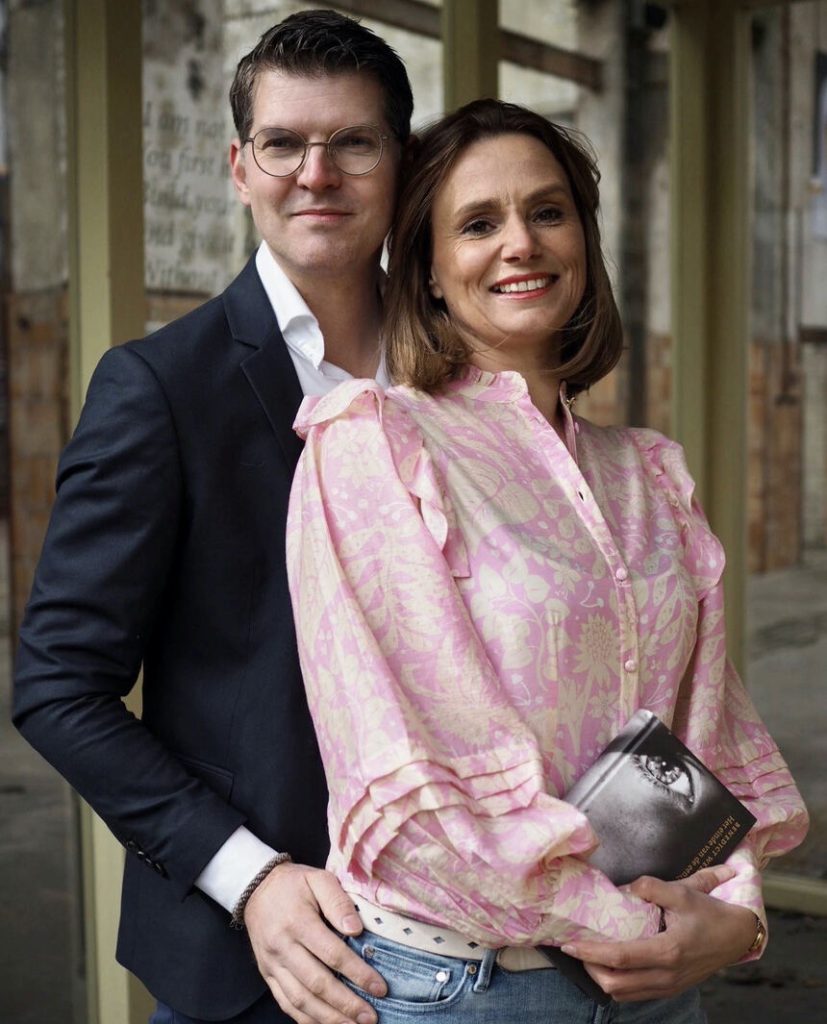
To feel confident, Guido invented a second self: the gigolo Tom Smith. After years of writing under a pen name, Marcia van der Schaaf wrote his story in Alias Tom, for the first time under her own name. In this interview, she talks about how she made his life read like a novel.
For years you wrote under the pen name Alicia Chris, and Alias Tom was the first book you published under your own name. What changed for you, and in your writing, when your own name went on the cover?
Deciding to use my own name didn’t take long. Our children were old enough at that point to understand the subject. Guido lays himself bare in the book, and it didn’t feel right to hide behind another name.
In that sense, the book was a coming-out for Guido and for me, and that was nerve-racking. Especially when we were up on stage at the KamaSutrA fair, a Dutch erotica fair. We had worked toward that moment for so long, and we were incredibly nervous. We could share that with each other, and that’s what made our project so special.
In my writing, the biggest change was that I hired a professional editor. That made the text so much better. Sometimes it’s just small things that need adjusting, and they have a big effect on the story.
Alias Tom doesn’t fit into a clearly defined genre. You call it narrative nonfiction yourself. Did that play a part in your decision to publish it through your own publishing company, Bloem Boeken? And what did self-publishing teach you that you hadn’t expected?
After the broadcast of Eus’ boekenclub, a Dutch TV book show, we started talking with several publishers. A hybrid publisher was out for me. But we were also in talks with a big publisher. After a number of conversations, we couldn’t quite reach an agreement.
After that, I ran out of patience waiting for a response from other publishers. I invested in developmental editing and line editing myself. The proofreading was done by another editor. I arranged a photo shoot for the cover and hired a designer for the interior and the cover. I did it myself, but I wanted a book that was every bit as good as a book from a publisher. I think I pulled that off.
Sometimes I’m sorry we didn’t find the right publisher, because they have a reach that Guido and I don’t have. This story is really suited to a wide audience. Unfortunately, you can’t get a foot in the door with magazines and talk shows. Still, we’ve sold almost a thousand books, and for a self-publisher that’s quite a lot.
What I learned from self-publishing is what it takes to make a book, in terms of organization, money, and time. I was working on it every day and didn’t get any writing done. That was unexpected, but it was also fun. I had the freedom to decide everything together with Guido. Maybe not everything was right from a marketing point of view, but we did get to stay true to ourselves.
My next book comes out in September, and that one is going through the publisher Just Publishers. The book will be in the catalog, and if we’re lucky it will be in every bookstore. It feels strange to me that I have to let go of a lot, and I’m curious what the difference in reach will be now that it’s going through a publisher.

With Alias Tom you did pretty much everything yourself, from the up-front financing to the press release. What did you find hardest about that entrepreneurial side of being a writer?
The business side wasn’t a problem for me; my husband and I have had our own company for years, so I didn’t worry about that part. But I did miss having time to write.
What disappointed me most was how hard it was to get attention for our book. There were people who had promised coverage in a newspaper, a magazine, or a talk show, but in the end didn’t follow through. I had bought copies on the strength of those promises.
Fortunately, Guido and I have found a way to turn that around, and now we have our own booth at book fairs, which is great fun. I talk with readers there, and I don’t get that with online sales. The book marks a personal journey for Guido and for me, and personal contact with readers is part of that.
You live partly in Andalusia and partly in the Netherlands. Do you write differently in one place than in the other? And if so, why?
Yes, I do think I write differently there. There’s more peace and quiet, and more space; especially when I’m there alone, I can really shut myself away. I have fewer obligations.
In the Netherlands, my mini library is also my office, and it’s the smallest, darkest room in the house, which can sometimes be nice too. But it contrasts with the blue sky and the light in Spain. There I often work outside on the covered patio.
Alias Tom is based on Guido’s true story, including domestic violence in his childhood. How did you handle the responsibility of telling the story of someone’s real, vulnerable life? What could go on paper and what couldn’t?
When Guido handed me a box with all his personal belongings in it, I felt honored. He entrusted me with his medical records, cards, letters, reports from child welfare services. We didn’t really talk about what could go in and what couldn’t.
Some parts are hard for the people around him to read. I changed physical features and names, but the people it’s about do recognize themselves in it. When I started this project, Guido was still married.
His wife, Fleur in the book, didn’t want any part in it. I respected that. There have been readers, though, who felt some background or depth was missing there, and I understand that.
The core of the book is an alter ego: the insecure Guido becomes the self-assured gigolo Tom Smith. How did you make that difference between Guido and Tom visible on the page, in voice and tone?
I think that came fairly naturally, because over the years I saw the difference in him. When we first met, he was fully in his gigolo role. Later, when we spent a few days together in a cottage on the Veluwe working on this book, I saw his Guido side.
For the reader, I tried to make it clear by changing the physical features that gave him that confidence.
The biggest compliment I got was from one of Guido’s regular clients, who said I had managed to capture his voice in this book.
How did you adjust your style in Alias Tom to keep it faithful and readable? Where did you add color, and where did you stick to the facts?
That was a challenge. When I wrote short stories, I often went to a hotel. I’d take a seat in the lobby and observe my surroundings. What kind of meetings were going on? A job interview? A blind date? A business meeting? I’d turn that into a story. Fiction, in other words. Now I had to stick to the facts. My goal was to take the reader by the hand through Guido’s story, so that it read like a novel.
In the beginning, I held back on adding color because I stuck closely to the facts. That was good for laying down the timeline. After that, I started adding more color. I changed places and physical features in particular.
The dialogue is plausible in those situations; it’s of course impossible to recall every conversation exactly, and sometimes dialogue is needed to push the story forward. Every scene in the book is based on a real event; nothing in it is made up.
There are intense scenes with Guido’s biological father, and yet he was at the launch. That was a special moment for me.
The book has explicit erotic passages alongside a painful childhood story. How do you write an intimate scene like that so it belongs to the story and doesn’t stand apart?
On days when I read all of Guido’s cards and letters from the children’s home, I put myself in the place of that eight-year-old boy who was there alone and felt abandoned.
From there, I couldn’t switch to the erotic. I wrote those stories at a different time. I struggled to connect those two parts. For a very long time, it felt to me like two separate stories, but in the end I managed it.
Three times a year you meet with the writers’ group Vlammende Verzinsels, after years of writing alone and publishing under a pen name. What do you get out of writing together?
I’d already started going to the writing meetings when I was still writing under a pen name. I’ve gotten an enormous amount out of them. It motivates me to write and to read. Everyone gives each other constructive feedback, and it’s cheaper than a writing course.
Do you work out a detailed plot in advance, or was the storyline already largely fixed because your book is based on a true story? And how did you deal with that?
Even though it’s a true story, I do work with a plot. Before I start writing, I look at the character and what his or her development will be. I build the timeline around that. I use The Artist’s Way by Julia Cameron and Save the Cat! Writes a Novel by Jessica Brody as tools.
What do you hope readers take away from Alias Tom? And why?
I think it’s a book that gives hope. Whatever you go through, try to accept it and move on. Guido has come a long way to become the man he is now. I think a lot of people could recognize themselves in this story.
What does an AI coach see in your writing?
Paste a passage of 300 to 900 words and read what works, what could be sharper, and what to tackle first. The coach quotes your own sentences and backs up every comment. It doesn't rewrite anything.
Your text is not used to train AI models. Privacy Policy
Want more coaching?
With a free account, your limit jumps to 20,000 characters per analysis, and every analysis comes with three deep-dive buttons tailored to your text.
Try another type of writing?
No credit card required.