Denise Hulst: “Many bestselling authors haven’t written the best books”


Years of work on the manuscript, one weekend on the marketing. That’s how most authors work, says writing coach and book marketing strategist Denise Hulst. In this interview, she talks about why most books sell poorly, how she can tell whether someone is stuck or procrastinating, and how she recognizes an AI sentence.
Under “writing coaching,” your website lists what you do when you work with a writer: untangle things for them, keep an eye on focus and pace, watch the through line. What usually goes wrong first with your clients?
Authors think they’re clear about what they want to write about, but when you keep asking, that often turns out not to be the case. As a result, they don’t have a sharp picture of their target audience, and the writing plan doesn’t hold up. And that’s not counting their doubts about their writing talent or skills.
On your homepage, you write that authors spend years on their manuscript and a weekend on their marketing, and that this is why books sell poorly: not because of the content, but because a strategy is missing. How often does the quality of the writing also play a role?
There are a great many bad books that sell well. That has everything to do with marketing. And there are lots of good books that sell poorly. That often has to do with a lack of marketing.
And I don’t even mean the publisher’s efforts, but the efforts the author personally makes (or doesn’t make, in fact) to be visible, or to set up a system that effectively and demonstrably contributes to the goal the author has set for themselves, long before the book comes out. That doesn’t mean quality plays no role.
But quality can be about different things: the manuscript itself and the way it’s written, of course, for example. But quality can also be about the design, the layout, the title, and the back cover copy.
A journalist or reviewer who is handed a book that doesn’t meet the quality standards (a good cover, a good layout, a catchy title, and back cover copy to match) sets that book aside.
They’re not going to spend their precious time on it. Sometimes the quality of the manuscript seems to matter less, and then it also looks as if it’s mainly the packaging that brings commercial success while the content disappoints.
Some bestselling authors are a major source of income for publishers, and there are countless bestselling authors who haven’t written the best books but do well because of other things, like personality or visibility.
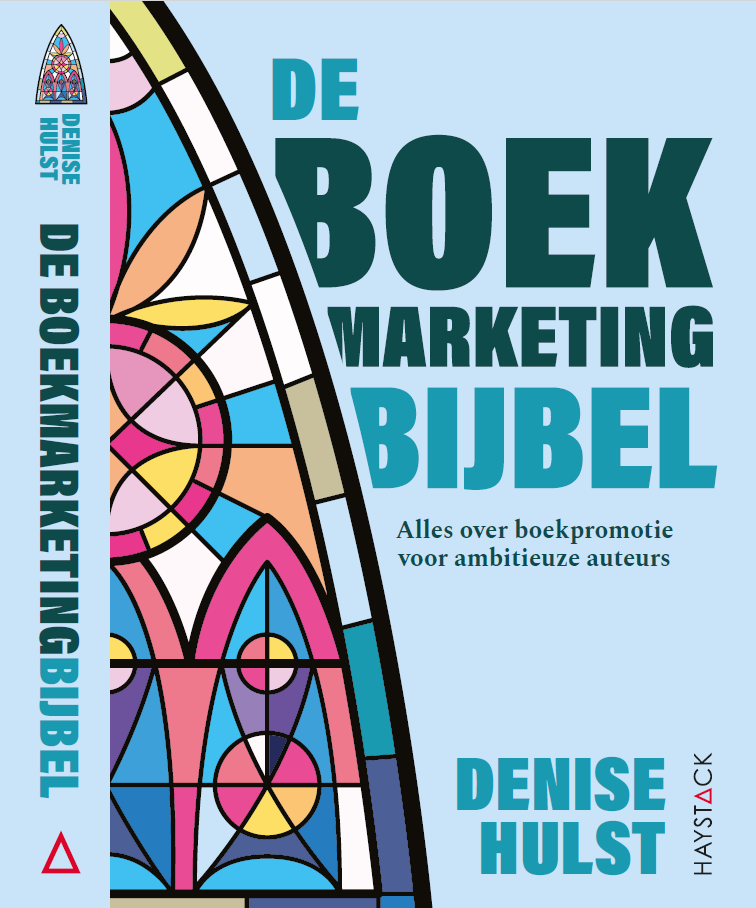
In your book De Boekmarketingbijbel (The Book Marketing Bible), you describe the Five Links of Effective Book Marketing, a system authors use to build a readership before their book even comes out. Which link do authors skip most often? And what does that cost them?
Fiction writers often skip Links 1, 2, and 5. They’re often on social media, though, and they see that as their most important marketing activity. To some extent that applies to nonfiction authors too.
Business nonfiction authors do have Link 1, but they don’t set it up so that it serves the higher goal: building an author platform that lets you sell your books for years and steadily build your name as an author, so that your fan base grows in a place that belongs to you and not to a Meta company. If you write purely for pleasure, of course, that doesn’t matter.
In your program, the writer sends in their text at least five days before the appointment, and you send it back with your feedback no later than two days in advance. You could also give that feedback during the appointment itself. So why send it two days ahead?
Because I want to read the manuscript properly first, or at least the number of pages agreed in advance. I need time for that.
And when I have an appointment to go through the manuscript (or the agreed pages), it’s also very helpful for the author to be able to take in the feedback first and think it over. That makes the time we spend together face to face more effective.
In a blog post on Uitgeverijgezocht.nl, you wrote about authors who cut corners on the making of their book. As in: “No editor, because I know perfectly well what I want to write. No proofreader, because Mom is good at Dutch.” How does that show up in a book like that?
Sentence structure, the structure of the story, grammar mistakes, use of language, sentence length.
On Boekschrijven.nl, an author you coached summed up your advice like this: start on your marketing before you have a decent chapter finished. What does that do to the text that still has to be written?
Nothing, because if all goes well you do know roughly what’s going to end up on paper. Besides, you certainly don’t have to talk about your book right from the start; instead, you have the time to set up your links properly, so that at some point the foundation is solid.
And once that’s solid, you can start building your author platform without having to wave your book around every five minutes. The idea is that in the months before your publication, you mainly try to get people who are interested in your subject or genre to connect with you.
And you do that by writing about yourself and your writing process, and about the subject of your book. That’s not the same as talking about your book. You only do that in the final stretch, when your book launch is coming up.
Starting a conversation, making the connection well before your book comes out, is a sustainable route to book sales and a solid foundation for your life as a writer, one that goes beyond a one-time spike in sales around your book launch.
With your clients, you go through their text with a pen. What does someone else get out of your text that you couldn’t have gotten out of it yourself?
Hmm, sometimes different sentence constructions that make a sentence flow better. Sometimes repetitions I overlook myself. Sometimes I go on too long and it could be shorter and more concise.
On your homepage, you write that when you coach a writer, you also check whether the manuscript is in line with the writing plan and the book idea. How can you tell that someone has strayed from their plan before they realize it themselves?
A writing plan is the foundation. You can see from a writing plan what the intention is. What the author wants to get across. So really the question is: does the final story match what the original intention was?
Kind of like buying a tub of yogurt, and when you open it, there seems to be chocolate cake inside. Then the packaging doesn’t match the contents. The question is: do I get what I expect to get?
On LinkedIn, you called writer’s block not a block but “incubation time with a bad PR department.” In that same post, you called waiting for inspiration nonsense, a disguised excuse to procrastinate. How can you tell whether someone is stuck or procrastinating?
I know the moment I invite an author to write something that has nothing to do with their book, or only indirectly, and nothing happens. Authors who enjoy writing are happy to pick up the pen, especially if you give them assignments that are out of the ordinary.
The point is that you start writing again. The fact that your scribblings have nothing to do with your book can free up a lot of room in your head. It’s okay for writing to be fun too, just like playing in the sandbox. Getting the joy back is the most important thing of all.
Do you come across books that are mediocre in their writing but do sell well? What are those authors doing right?
Some authors have an exceptionally good feel for commerce and marketing and know perfectly well how to put themselves in the spotlight. And visibility sells.
If you keep telling your story tirelessly and convincingly and keep putting yourself in the spotlight, and you have a watertight system like the Five Links, you’re planting the right seeds. Then the quality of your book matters less than your personality.
On LinkedIn, you wrote that for a long time you thought that in nonfiction you could hide behind knowledge and experience. You now call that utter nonsense, because in nonfiction too, the author comes through in everything. How can you tell from a manuscript that someone is still hiding?
Using jargon, a distant way of writing, not working in personal experiences, not talking about “I” but only about “one” or “research shows.”
Of course you don’t have to air your entire private life in public, but it’s about the way you phrase sentences and use language. With language, you can deliberately create distance, or do just the opposite and make a connection.
In a piece on Boekschrijven.nl, you wrote that your expertise lay in platform and promotion, not in the writing itself. Writing coaching is now one of your services. How did that come about?
That happened naturally. All told, I’ve written thirteen books and had the best editors. In fact, I learned the craft from those wonderful professionals.
Now and then I’d read someone else’s manuscript, and I’d see very quickly what was off and what was needed to improve a text. I’ve developed a sixth sense for badly written passages, something like that, I think.
Beyond that, I find it very rewarding, because you see the results of your efforts right away, or of the authors’ efforts when I give writing advice that they actually follow.
What do you notice about writers using AI on their text, and how do you deal with it?
I simply tell them: “Do something about those AI sentences, because they all look alike.” There are about six things I recognize them by: the em dash, “Not because… but because,” “Not this, but that,” “Honestly?” or “An uncomfortable truth.”
What does an AI coach see in your writing?
Paste a passage of 300 to 900 words and read what works, what could be sharper, and what to tackle first. The coach quotes your own sentences and backs up every comment. It doesn't rewrite anything.
Your text is not used to train AI models. Privacy Policy
Want more coaching?
With a free account, your limit jumps to 20,000 characters per analysis, and every analysis comes with three deep-dive buttons tailored to your text.
Try another type of writing?
No credit card required.