HOW IT WORKS
Feedback anytime. Better every time.
On your schedule.
You want to know how good your writing is, right now. What works, what doesn’t, and why.
Feedback on writing takes time. And a coach isn’t always available when you need one.
ViaScripta is there for you whenever you need feedback.
Feedback on your writing.
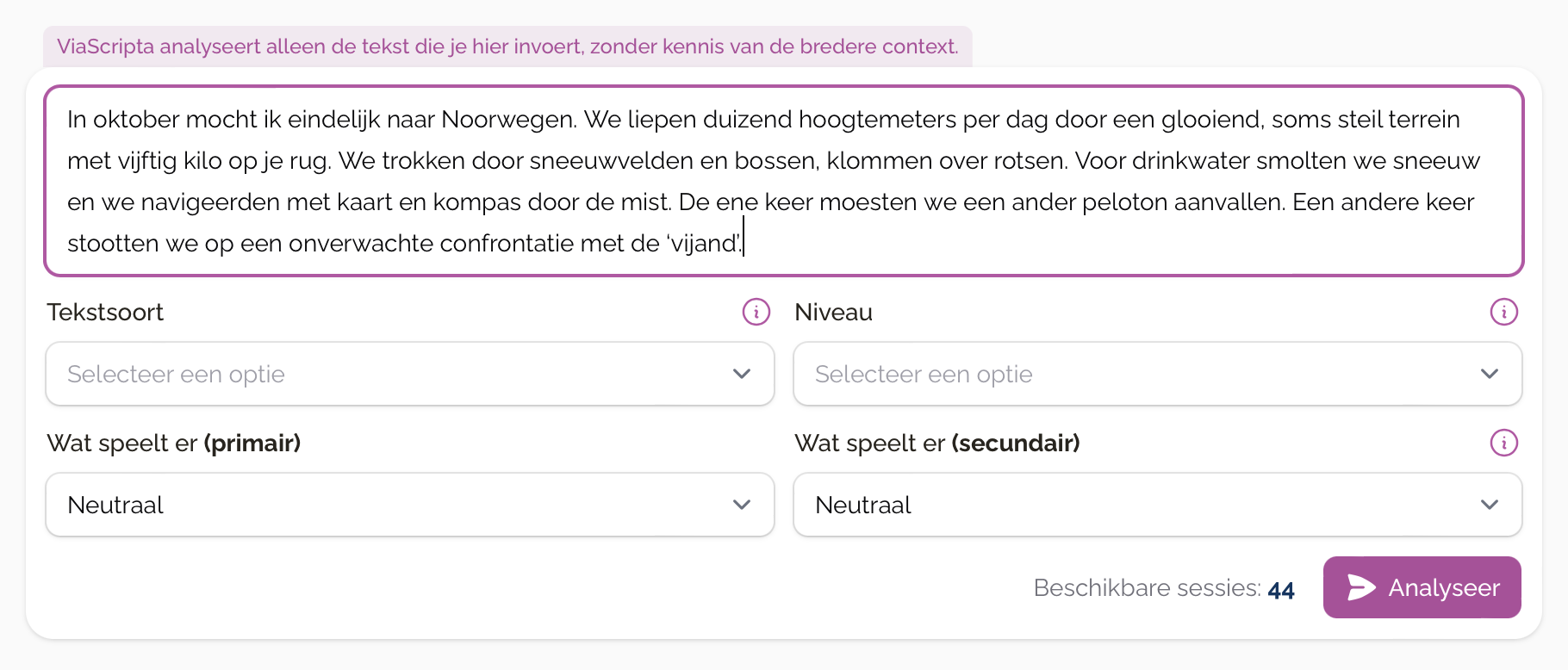
Paste your text.
Choose your type of writing, set your level, pick what’s going on in the text, and hit “Analyze”.
Get feedback.
Within half a minute you know what works, what doesn’t, and why.
Dive deeper.
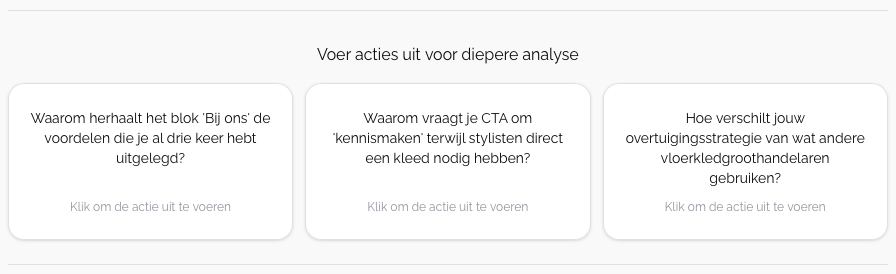
Use the deep-dive buttons to zoom in on specific areas for improvement.
Learn the rules, then apply them.
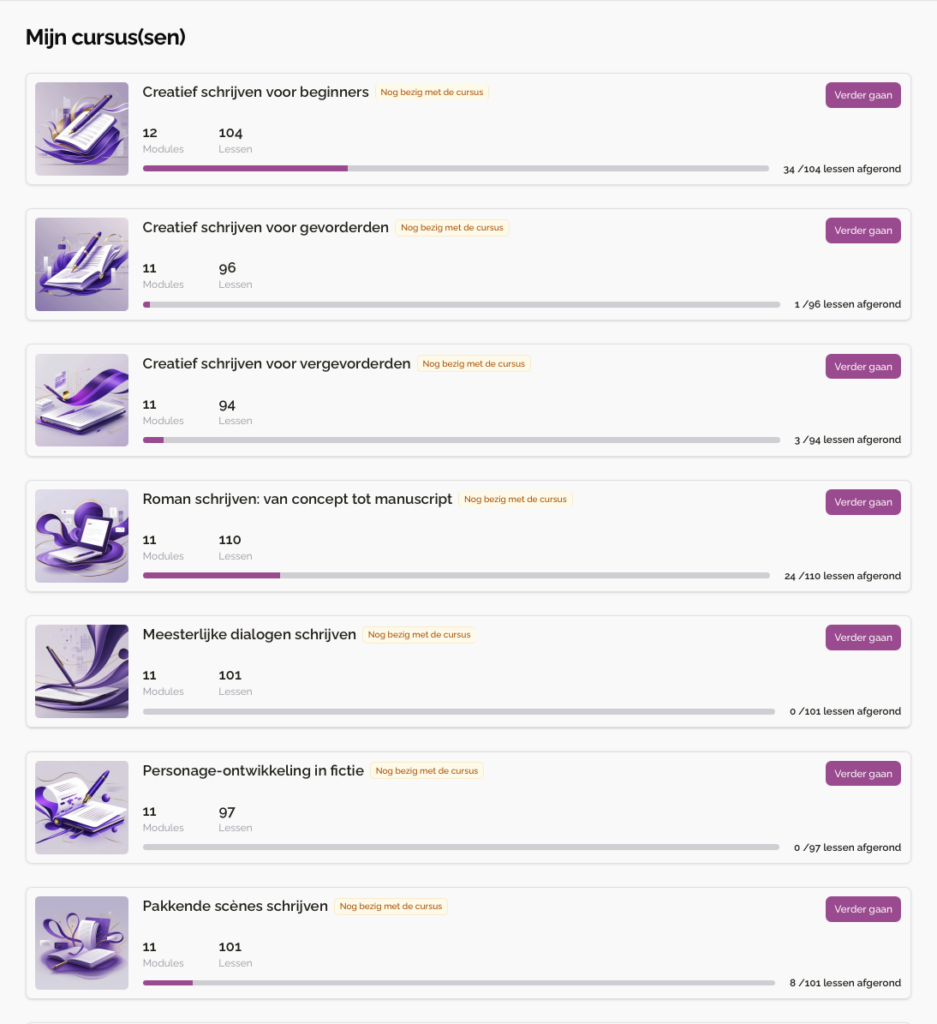
Choose a course.
From creative writing to dialogue, character development, nonfiction, and storytelling.
Learn and practice.
Theory in short lessons, followed directly by writing exercises in every module.
Get feedback on your exercise.
Paste your draft into the Writing Coach and get feedback right away.
See exactly what the coach points out, from fiction to LinkedIn.
She opened the front door and stepped into the hall. The smell of the old days came to meet her and touched her more than she had expected. Everything was still exactly the same, and that was precisely what made her emotional. Without meaning to, she thought of her mother, who had always stood here in the kitchen.
“Hello,” said a voice.
Marleen turned around. It was her brother Peter, whom she hadn’t seen in years.
“Hello, Peter,” said Marleen. “How are you?”
“Good,” said Peter. “And you?”
“I’m good too,” said Marleen. “It’s been a long time.”
“Yes,” said Peter. “A very long time.”
Marleen was glad to see him, but at the same time she also felt a kind of tension. Something had happened between them long ago, but she didn’t want to think about that now. She decided to just stay quiet about it.
They walked to the kitchen together. Peter made coffee in the dented percolator that had stood there back then too, and Marleen sat down at the table where she had always eaten as a child. Marleen’s heart was pounding in her throat. She didn’t really know what to say. The situation was awkward and charged.
“Why did you actually come back?” Peter asked after a while.
Marleen herself didn’t actually know exactly either. Something had drawn her here, a feeling deep inside. Maybe it was time to put the past behind her. Maybe she just wanted to know whether the house was still standing. She shrugged.
“I don’t know,” she said honestly.
Peter nodded understandingly. He understood, or at least he pretended to. Outside it began to rain softly, and the drops tapped against the window like tears. It was a day full of emotions and old wounds that might finally heal.
You name the emotion the scene already carries
The dented percolator and the smell of the old days already do the work. But “sad” and “nostalgic and sorrowful” stick a label on it and take the experience out of the reader’s hands.
STEP 1: What Works
The percolator does its job. One concrete detail (“the dented percolator that had stood there back then too”) anchors the scene in a shared past without the narrator having to name it. That is exactly how a setting starts doing character work.
The rhythm of the dialogue in the greeting scene has something that works: the emptiness in it. “How are you?” / “Good,” / “And you?” / “I’m good too”: the banality says more than a loaded opening line would. Social noise as an emotional buffer zone is a legitimate choice.
STEP 2: What Could Be Better
Problem: telling overrides what the scene is already doing.
Passage: “Marleen felt sad… she felt nostalgic and sorrowful at the same time” (paragraph 1); “The situation was awkward and charged” (paragraph 5).
Why: The text systematically names what it shows, or could show. “Nostalgic and sorrowful” aren’t observations. They’re labels that take the interpretation away from the reader. At the Intermediate level, this is the core problem: the narrator doesn’t trust the scene enough to let it work. That undermines the rare moments when the text does get concrete (the percolator, the smell, the table). Those moments drown in direct explanation of emotion.
Suggestion: Before: “Marleen felt sad when she saw the old house in front of her again.” After: start with what she sees (the house) and let the emotion sit in her reaction, not in naming it. A detail like the color of the paint, a cracked sidewalk, something that’s off, or something that hasn’t changed at all: that’s what carries the charge. The same goes for “The situation was awkward and charged”: the dialogue already shows that. Coming after the dialogue, the sentence is redundant.
Effect: The reader experiences the emotion firsthand instead of being told. The writing gets tighter.
Point to address: the tension between brother and sister stays empty.
Passage: “Something had happened between them long ago, but she didn’t want to think about that now. She decided to just stay quiet about it.” (paragraph 6)
Why: This is a narrative promise with nothing behind it. A vague reference to a conflict activates the reader, but if that activation doesn’t connect to anything, it feels like a false start. The problem isn’t that the conflict stays unresolved (that can be a deliberate choice). The problem is that it’s named as something that exists, without picking up any charge through behavior, tone, or dialogue. The sentence “She decided to just stay quiet about it” is also a paraphrase of what silence itself already communicates.
Suggestion: Let the conflict play out in what Marleen does or doesn’t do during the conversation: an avoided glance, a question she swallows, a moment when Peter says something and she answers differently than you’d expect. Or cut the reference if the conflict has no function in this scene.
Effect: The tension gets texture; the reader feels something that goes unsaid, instead of reading that something goes unsaid.
Room to refine: the closing metaphor.
Passage: “the drops tapped against the window like tears… old wounds that might finally heal.” (ending)
Why: Both images are generic. The rain-as-tears comparison is so worn out that it no longer does any work; “old wounds” is a cliché that actually flattens the emotional openness of the ending. By this point, the scene has built up enough to end without an explanatory metaphor.
Suggestion: Trust what’s already there. A closing line that stays with the percolator, the table, or the silence (concrete, without interpretation) is stronger than a metaphor that tells the reader what to feel.
Effect: The ending gets resonance instead of closure; the reader carries the scene with them.
STEP 3: Next Step
Rewrite the first paragraph entirely without the word “feel” or any synonym for it, and without naming a single emotion. Use only what Marleen sees, hears, or does at the moment she stands in front of the house. Then test whether the emotional charge of the scene stays intact, and if it does, apply the same discipline to the rest of the text. This passage has the ingredients; the question is whether the narrator can let them stand on their own.
Two other candidates were already sitting in the waiting room. One of them checked her phone every few seconds and then put it back in her lap, screen down. The other had a newspaper open but didn’t turn a page. Thomas picked up a magazine, leafed to the middle and back again, and put it down. Then his name was called.
The interview took place in an office on the second floor. Ms. De Wit asked him various questions about his experience, his education, and his previous jobs, and Thomas answered all of them. It actually went pretty well, although he was a little unsure of himself now and then. She seemed interested, or maybe not. That was hard to tell. At one point she asked why he wanted to work here, of all places. Thomas gave an answer, but it sounded hollow, even to his own ears. After that they talked a bit about practical matters, like salary and working hours, and after half an hour it was over.
Ms. De Wit shook his hand and said he would hear something soon. Thomas thanked her and walked outside, onto the busy street. He wasn’t really sure whether it had gone well or not.
Two weeks later he got an email. He’d been hired. Thomas was happy, though to his own surprise he noticed that the happiness was smaller than he had expected. Whether he really wanted this job, he still didn’t actually know. But that would no doubt become clear later.
You summarize the interview where it needs to become a scene
The waiting room comes alive, because you show behavior. But the key question (why does he want to work here?) and his hollow answer are only reported; the reader doesn’t hear the emptiness.
STEP 1: What Works
The waiting-room scene is the strongest part of the text. The three candidates are written through behavior, not through their state of mind: the woman who turns her phone over, the man who doesn’t turn a page, Thomas leafing through the magazine and putting it down. Those are three variations on the same theme (waiting as an active not-knowing) without the narrator naming it. Focalization and restraint work together exactly right here.
The opening also does what it needs to do: “his hands were clammy” and standing too long at the front desk are concrete, functional details that make the stakes of the scene clear right away, without psychological explanation.
STEP 2: What Could Be Better
Problem: the interview itself is summarized instead of dramatized.
Passage: “Ms. De Wit asked him various questions about his experience, his education, and his previous jobs, and Thomas answered all of them.” Third paragraph, first two sentences.
Why: The waiting-room scene builds tension through dramatization at the scene level. After that, the text switches to summary: a deliberate technique, but used in the wrong place here. The interview is the central event, the place where the stakes (does he want the job? will he get it?) become concrete. Summarizing, or compressing, is functional when a scene isn’t structurally relevant; this one is. One sentence stands out: “At one point she asked why he wanted to work here, of all places. Thomas gave an answer, but it sounded hollow, even to his own ears.” That’s the dramatic heart of the scene, but it’s there as a narrated observation, not as a moment. The reader doesn’t experience the emptiness; it gets reported.
Suggestion: Give that one question room as a scene. Don’t write out the whole interview, just that question, and Thomas’s answer in direct or indirect speech, followed by the silence or De Wit’s reaction. Before: “Thomas gave an answer, but it sounded hollow, even to his own ears.” After: something along the lines of De Wit following up, or not following up: a behavioral detail that confirms the emptiness without naming it.
Effect: The thematic core of the text (the gap between wanting something and knowing that you want it) becomes something the reader feels instead of something they’re told.
Point to address: the closing sentence repeats what the text has already shown.
Passage: “Whether he really wanted this job, he still didn’t actually know. But that would no doubt become clear later.” The last two sentences.
Why: The ambivalence is already there earlier in the text: the hollowness of his answer, the happiness that’s smaller than expected. The closing sentence spells out what the text has built up implicitly, a kind of thematic overstatement that undermines the restraint of the rest of the text. “But that would no doubt become clear later” adds another narrative promise that the text doesn’t keep (and in a short standalone scene doesn’t need to keep), which makes it feel a bit like stating the obvious.
Suggestion: End on behavior or observation, not on interpretation. The sentence “Thomas was happy, though to his own surprise he noticed that the happiness was smaller than he had expected” is already a strong landing; it can carry the text. Everything after it explains what the reader already understands.
Effect: The text ends with the tension intact, without pushing the interpretation into the reader’s hands.
STEP 3: Next Step
The waiting-room scene works because each character expresses the same inner conflict through a different pattern of behavior. Apply that technique to the job interview itself: show the scene through De Wit’s behavior. How she listens and how she reacts to the hollow answer (a small movement, a question she does or doesn’t ask) make the scene dramatic without Thomas’s point of view having to become explicit. De Wit then becomes a mirror that reflects the emptiness of Thomas’s answer back without naming it.
During sleep, the body goes through several cycles in which the NREM and REM phases alternate. These phases are when recovery takes place: the brain processes the impressions of the day, memory consolidates, and homeostatic sleep pressure gradually decreases. Circadian rhythm plays a guiding role in this. Anyone who disrupts that rhythm soon notices the consequences.
Sleep has a big influence on daily functioning. People who sleep poorly perform worse, have more trouble concentrating, and are more prone to a low mood. In the longer term, too, a lack of sleep affects health. So the impact on daytime functioning should not be underestimated.
Yet many people sleep worse than they would like to. Screen use in the evening plays a role, because it inhibits the production of melatonin. Caffeine and stress also contribute to a restless night. These are factors we partly have control over ourselves.
There are, then, various ways to improve sleep. A regular routine, a dark and cool bedroom, and enough daylight during the day help the body settle into a healthy rhythm. It sounds simple, and in a sense it is, though in practice it often turns out to be harder to keep up than expected.
Sleep, in short, deserves more attention than we usually give it. It’s a subject that concerns everyone, and that’s exactly why it’s good to stop and think about it now and then.
Your conclusion repeats your introduction instead of growing out of it
The first and last paragraphs say the same thing: sleep is underestimated. The physiology in between deserves a sharper ending. Right now you’re drawing a circle instead of a line.
STEP 1: What Works
The text is clearly structured: from underestimation to physiology, to consequences, to causes, to solutions. That structure works for an informative piece and gives the reader something to hold on to.
The second paragraph is the strongest. The reference to NREM/REM cycles, memory consolidation, and circadian rhythm gives the text scientific weight without getting bogged down in detail. That’s a deliberate choice that fits the register.
The sentence “It sounds simple, and in a sense it is, though in practice it often turns out to be harder to keep up than expected” is one of the few places where the text corrects itself. That kind of nuance makes an informative text more credible.
STEP 2: What Could Be Better
Point to address: a circular structure makes the text less persuasive.
Passage: paragraph 1 (“A good night’s sleep is often underestimated”) and paragraph 6 (“Sleep, in short, deserves more attention”) are identical in content.
Why: The text opens and closes with the same claim, without adding anything to that claim in between. The conclusion repeats the introduction instead of growing out of it. For an experienced reader, that feels like a missed opportunity: the physiological and behavioral information in the middle paragraphs justifies a sharper or more specific closing claim. The circle is closed, but not deepened.
Suggestion: Before: “Sleep, in short, deserves more attention than we usually give it.” After: pick up on the tension that paragraph 5 already touches on, that the solutions are known but people don’t stick to them. A conclusion that takes on that tension gives the text a point the reader takes away.
Effect: The text gets a direction instead of a circle. The reader leaves the piece with something new, not with a repetition of what they already knew.
Point to address: paragraph 3 is a list without an anchor.
Passage: “People who sleep poorly perform worse, have more trouble concentrating, and are more prone to a low mood.” (paragraph 3)
Why: The consequences are listed without any one of them being developed or illustrated. Combined with the closing sentence of that same paragraph (“So the impact on daytime functioning should not be underestimated”), this creates a double abstraction: the list is already generic, and the closing sentence repeats that generality once more. For an experienced reader who already has the basic knowledge, this adds little. The physiological precision of paragraph 2 isn’t carried through here.
Suggestion: Choose one consequence and make it concrete, not as an anecdote but as a mechanism. For example: the relationship between sleep deprivation and prefrontal dysfunction explains both concentration problems and mood swings in one move. That’s more compact and more informative than three separate items.
Effect: Paragraph 3 matches the level of paragraph 2, and the text loses its split between sharp physiology and vague consequences.
Room to refine: “These are factors we partly have control over ourselves.”
Passage: closing sentence of paragraph 4.
Why: The sentence is a qualification without a function. The word “partly” acknowledges that not everything can be controlled, but the text does nothing further with that caveat. It’s a cautious reflex that ends the paragraph without closing it. In a text that is otherwise fairly assertive, this hesitant tone stands out.
Suggestion: Cut the sentence, or use the caveat as a bridge to paragraph 5; right now the transition to concrete advice is abrupt. If the reader knows why some factors can be influenced and others can’t, the transition to solutions follows more logically.
Effect: Better cohesion between paragraphs 4 and 5; the text loses a dead sentence and gains a functional transition.
STEP 3: Next Step
The text has a strong physiological middle section (paragraph 2) that is never picked up again. The consequences and solutions float free of the mechanism explained earlier. Technique: use the physiology as an explanatory framework for the rest of the text. Concretely: when you write about screen use and melatonin suppression, link it explicitly back to the circadian rhythm you introduced in paragraph 2. Not as repetition, but as application, so the reader sees that the causes and the solutions come from the same mechanism. That gives the text internal logic, so it no longer reads as a string of separate paragraphs.
Every summer vacation I stayed there for a few weeks. My grandma lived in a small village, in an old house with a big garden. It was always cozy there and I felt at home. We did all kinds of things together and I loved it there.
In the mornings she made oatmeal for breakfast. Then we often went out into the garden, where she grew vegetables, and I got to help with the weeding and watering. In the afternoon we drank tea and ate cookies from an old tin. And sometimes we went for a walk in the woods nearby.
My grandma was a sweet and warm woman. She always had time for me and listened to my stories. I could tell her anything. She made me laugh and I felt safe and appreciated with her. It really was a special bond.
The years went by and I got older. I went off to college and came by less and less often. Time flew by before I knew it. When my grandma died, I was devastated. The house was sold and other people moved in.
Sometimes I still drive past it. It looks different now, but the memories have stayed. They have left an indelible impression on me.
What I learned from those summers is that you have to enjoy the time with the people you love, because before you know it, that time is over. My grandma taught me that, and I will never forget it. I still treasure the memories of her house every day.
You describe your grandma with adjectives, not with scenes
The morning scene (the oatmeal, the old cookie tin) shows that you can be concrete. But “sweet and warm woman” and “special bond” are conclusions; the reader never really meets her.
STEP 1: What Works
The concrete morning scene in paragraph 3 is the strongest passage in the text. The “oatmeal for breakfast,” the old tin of cookies, the weeding in the garden: here the text works by showing instead of telling, and this is the only place where the reader actually sees and feels something. The details are specific enough to be believable and generic enough to feel familiar. That’s exactly what nostalgic nonfiction needs.
The structure is clear and functional: chronological, from childhood to loss to reflection. For this genre, a solid choice that carries the reader along effortlessly.
STEP 2: What Could Be Better
Problem: abstract characterization dominates the text.
Passage: “My grandma was a sweet and warm woman. She always had time for me and listened to my stories. I could tell her anything.” (paragraph 4), but this pattern runs through the whole text.
Why: The relationship with your grandma is the emotional heart of this piece, but it is presented almost entirely through adjectives and abstract claims: sweet, warm, special bond, safe and appreciated. These are conclusions, not evidence. The reader gets no access to the woman herself: her voice, her behavior, her quirks. Paragraph 3 shows that the writer can be concrete; the problem is that this technique isn’t carried through to the person at the center. In narrative nonfiction at the Intermediate level, characterization through behavior and detail is the standard, not characterization through labels.
Suggestion: Before: “She made me laugh and I felt safe and appreciated with her.” After: one specific moment (what she said, what she did, how she reacted) that shows why she was special. Not the conclusion, but the scene that earns the conclusion.
Effect: Your grandma becomes a person instead of a type. The emotional claim of the text gets something to stand on.
Point to address: the loss gets skipped.
Passage: “When my grandma died, I was devastated. The house was sold and other people moved in.” (paragraph 5)
Why: The death is the dramatic turning point of the text: the moment when the world that was built up so carefully disappears. But it’s dealt with in two sentences, the second of which (“other people moved in”) is factual. “I was devastated” is, once again, a conclusion. The text spends more space describing the coziness than the loss that makes that coziness final. That throws off the emotional proportions: the reader is prepared for a landing that never comes.
Suggestion: No need for an extended grief scene, just one concrete detail that makes the loss felt. What was the first thing you saw, thought, or did? The emptiness of a specific object, a habit that suddenly had nowhere left to go. That’s enough.
Effect: The turning point gets weight, so the closing reflection can earn its place.
Room to refine: the closing moral neutralizes the effect.
Passage: “What I learned from those summers is that you have to enjoy the time with the people you love, because before you know it, that time is over.” (paragraph 7)
Why: An explicit moral at the end is a familiar pitfall in personal nonfiction: the writer sums up what the reader has already understood, or should have understood. It shows a lack of trust in the reader and in the text itself. The sentence is also a cliché, not because the thought is untrue, but because the wording carries no trace of this particular grandma, these particular summers.
Suggestion: End with a concrete image instead of a conclusion. The last sentence of paragraph 6 (“the memories have stayed”) is already stronger. Or return to a detail from the text: the tin, the oatmeal, the garden. Let that image do the work.
Effect: The text ends with resonance instead of instruction.
STEP 3: Next Step
The morning scene in paragraph 3 works because the details function metonymically: the tin of cookies stands for more than cookies. Apply that technique to your grandma herself. Choose one object, habit, or saying that carries her character (something that was hers alone) and let it come back in the text, including in the passage about the loss and in the closing passage. That way you build an internal motif that ties the text together without having to spell out its meaning.
FlowDesk Pro was developed with the latest technologies. Our platform features an intuitive interface, real-time synchronization, advanced API integrations, a robust permission system with granular access control, extensive reporting modules, configurable dashboards, automatic backups in multiple regions, and a scalable microservices infrastructure that is fully GDPR compliant.
In addition, FlowDesk Pro supports single sign-on, multi-factor authentication, webhooks, custom workflows, an extensive settings environment, and hundreds of configuration options. Our system runs on a distributed Kubernetes cluster with load balancing and automatic failover.
We believe in synergy and in unburdening our customers through a holistic approach to enterprise resource management. FlowDesk Pro is the solution that integrates seamlessly with your existing tech stack and is future-proof.
Many companies choose FlowDesk Pro. Teams say it saves them several hours a week, because data no longer has to be retyped by hand. Whether you’re a small business or a large enterprise, FlowDesk Pro adapts to your needs.
Our mission is to make software that works. We continuously invest in innovation and in the further development of our product, so you can always count on the latest features and the best performance.
FlowDesk Pro is available in several subscription options. There’s a Basic package, a Plus package, and an Enterprise package, each with its own terms and features.
Would you like to know more about what FlowDesk Pro can do for your organization? Feel free to take a look at our website for more information about everything our platform has to offer. You can also consult our documentation there.
FlowDesk Pro. Software for the future.
You list features without saying what’s in it for the reader
“Granular access control,” “Kubernetes cluster”: the reader gets a catalog, not a promise. And “feel free to take a look” is the lowest urgency a CTA can have.
STEP 1: What Works
Social proof is present. “Teams say it saves them several hours a week, because data no longer has to be retyped by hand”: this is the strongest sentence in the whole text. Concrete, customer-focused, results-focused.
Scalability is addressed. “Whether you’re a small business or a large enterprise” signals broad applicability, which is a legitimate positioning choice for platform copy.
STEP 2: What Could Be Better
Problem: a feature dump with no benefit to the reader.
Passage: paragraphs 2 and 3 in full, from “intuitive interface” through “automatic failover.”
Why: Listing features without framing the benefit doesn’t trigger purchase intent. The reader processes a catalog, not a promise. “Granular access control” and “distributed Kubernetes cluster” are technical specs that only mean something once the reader knows what problem they solve. Without that translation step, this lands as brochure boilerplate, and in B2B copy that’s a conversion killer, because decision-makers ask what this means for them, not how it works under the hood.
Suggestion: Before: “robust permission system with granular access control.” After: “Decide exactly which data each employee sees, without needing IT.” Choose three or four core features and translate each one into a concrete use case or pain point. Move the rest to a features page or the documentation.
Effect: Readers recognize their situation, the value proposition becomes tangible, and the CTA gets something to move toward.
Point to address: the value proposition is generic and inward-looking.
Passage: “We believe in synergy and in unburdening our customers through a holistic approach to enterprise resource management.”
Why: This is an internal perspective used as an external argument. Words like “synergy,” “holistic approach,” and “unburdening” are semantically empty in copy: they describe the vendor’s intention, not the outcome for the buyer. Add to that “future-proof” and “integrates seamlessly with your existing tech stack”: these, too, are claims without proof or specificity. The reader has no reason to believe any of it.
Suggestion: Replace the mission language with a sharp positioning sentence that names the distinctive advantage. What does FlowDesk Pro do that alternatives don’t, or do better? Something like: “FlowDesk Pro replaces [X separate tools] with one environment: no data loss, no months-long implementation.”
Effect: Credibility goes up, and the value proposition stands out from the competition.
Point to address: the CTA has no pull.
Passage: “Feel free to take a look at our website for more information about everything our platform has to offer.”
Why: “Feel free to take a look” is the lowest urgency copy can express. There’s no incentive, no specific next step, no expectation set for the reader. As a CTA promise, “more information” is also generic: it doesn’t tell the reader what they’ll get when they click. In conversion copy, the CTA is the last chance to get the reader moving; vagueness here costs you directly.
Suggestion: Before: “Feel free to take a look at our website.” After: “Schedule a 20-minute demo and see how FlowDesk Pro fits into your workflow.” Or, if a demo isn’t the action you want, specify what the reader will find (free trial, ROI calculator, case study).
Effect: Lower drop-off at the moment of conversion, higher-quality leads.
STEP 3: Next Step
Apply the PAS framework to the opening paragraph. Right now the text opens with a product (“Meet FlowDesk Pro”), and the reader has no foothold yet. PAS (Problem → Agitate → Solve) works better here: open with the target audience’s recognizable situation, briefly sharpen the pain point, then introduce FlowDesk Pro as the logical solution. The social proof sentence that’s currently halfway through (“data no longer has to be retyped by hand”) is actually the core of the problem FlowDesk Pro solves. That’s your opening, not your fifth paragraph. Pull that pain to the front, build the rest around it, and the whole text gets the narrative thread it currently lacks.
Our Hydrating Day Serum is the finest example of that. It’s made with pure, carefully selected ingredients and gives your skin exactly what it needs. The result is healthy, radiant skin that lets you feel completely like yourself again.
We believe beauty should be honest. That’s why we deliberately choose natural ingredients and sustainable packaging. Being good for your skin is, for us, the same as being good for the world, and we’re proud of that.
The serum absorbs quickly and feels light. You use it morning and evening, after cleansing your face. One pump is enough for your whole face, and with daily use the bottle lasts about two months.
More and more people are discovering Bloei and making the serum part of their daily routine. We get lots of enthusiastic responses, and in the end, that’s what we do it for.
Bloei is more than a brand. It’s a promise: pure, honest, and free of unnecessary additives. We warmly invite you to get to know our world.
Curious? Feel free to take a look at our online store and discover the full range. For more about our ingredients and the way we work, you can also visit our website.
Bloei. Pure for you.
Lots of “we,” not much “you”: the reader isn’t the main character
The brand voice is warm and consistent, and the usage paragraph gives real guidance. But the copy mostly looks inward (what we believe, what we’re proud of) while the reader and what they get out of it stay out of the picture. On top of that, the claims that are there don’t set the brand apart, and the social proof and the CTA stay vague.
STEP 1: What Works
The tone of voice is consistent: warm, accessible, and true to the brand. In the closing line, “pure, honest, and free of unnecessary additives” connects semantically with the brand promise built up earlier in the copy; that’s solid brand thinking. The usage paragraph (absorbs quickly, feels light, one pump, two months) is functionally clear and gives the reader concrete guidance without breaking the rhythm. Brand identity and product presentation are separate but connected, which is structurally right for product copy.
STEP 2: What Could Be Better
Point to address: the copy is about the brand, not the reader.
Passage: “what we get up for every morning” (paragraph 1), “We believe beauty should be honest” and “we’re proud of that” (paragraph 3), “that’s what we do it for” (paragraph 5).
Why: Almost everywhere, the text looks at things from the brand’s point of view: what we believe, what we get up for, what we’re proud of. The reader and their situation (skin that needs attention, a result they want) are rarely the subject. In conversion copy, the reader should be the main character; the brand’s values and pride are not a reason to buy on their own. This inward focus also feeds the next point: because the copy looks inward, the claims stay abstract instead of spelling out what the reader gains.
Suggestion: Flip the perspective and make “you” the subject. Start with the reader’s situation or wish and translate each brand value into what it gives the reader: not “we deliberately choose natural ingredients,” but what the reader gets out of that choice.
Effect: Readers recognize themselves in the text; relevance and engagement go up, and the claims naturally get a more concrete hook.
Point to address: empty brand rhetoric outweighs the value proposition.
Passage: “All our products are put together with care and love, because your skin deserves only the very best” (paragraph 1) and “gives your skin exactly what it needs” (paragraph 2).
Why: These are interchangeable claims: statements any competitor could adopt without the slightest friction. They don’t trigger a specific mental image and offer zero differentiation. The copy leans heavily on affective framing (“care and love,” “the very best,” “radiant skin”) without anchoring those claims in anything tangible. That creates a credibility gap: the reader senses the intention but misses the substance that turns trust into conversion.
Suggestion: Before: “gives your skin exactly what it needs.” After: link it to one or two key ingredients with a short functional claim, for example a hydrating effect from ingredient X, or an effect you can feel within a certain period (provided you can back it up: cosmetics are subject to rules about what you may claim about how a product works). That gives the affective language an anchor.
Effect: The brand warmth stays intact, but the value proposition becomes credible. Readers who are on the fence get won over.
Point to address: the social proof is vague and therefore weak.
Passage: “More and more people are discovering Bloei and making the serum part of their daily routine. We get lots of enthusiastic responses” (paragraph 5).
Why: “More and more people” and “lots of enthusiastic responses” are quantitatively hollow. They create the appearance of social proof without delivering the evidence. In conversion copy, social proof only works if it’s specific enough to be believable. Vaguely worded proof claims can even trigger suspicion in critical readers, especially in a category (skincare) where skepticism runs high.
Suggestion: Replace it with a concrete quote, a number of reviews, a percentage of satisfied customers, or a specific statement that illustrates the user experience. If that material doesn’t exist, cut the paragraph and let the product description speak for itself.
Effect: Higher credibility, less noise, a stronger trust signal on the way to conversion.
Room to refine: the CTA lacks urgency and direction.
Passage: “Curious? Feel free to take a look at our online store and discover the full range” (paragraph 7).
Why: “Curious?” is a rhetorical question that makes the reader’s next step optional. “Feel free” deliberately lowers the barrier, but it also reinforces the noncommittal feel. The CTA also splits attention: the online store and the website are both offered, with no hierarchy. That’s a classic case of CTA dilution: two directions mean fewer clicks on either.
Suggestion: Choose one primary action, phrase it as an action, and give the reader a reason to click now. “Feel free” can go once the copy has built up enough trust, and the rest of the text certainly aims to do that.
Effect: Higher click-through rate on the primary action, a sharper conversion funnel.
STEP 3: Next Step
Laddering the brand promise is the technique that pays off most here, because it solves the two biggest issues in one move. Right now the copy communicates at brand level (“honest, pure, natural”) but skips the step to product feature and reader benefit. Laddering connects a brand value, through a concrete feature, to an emotional end benefit for the reader: from what it is, to what it does, to what it means for me. That anchor makes the claims concrete and shifts the perspective to the reader, exactly the two things the copy is missing right now. Apply that structure to the first two paragraphs; that’s where the biggest opportunity lies.
According to the city, the homes are badly needed. The city has been dealing with a shortage for some time, and first-time buyers and young families in particular have trouble finding affordable housing. The new plan is meant to change that.
Not everyone is convinced, however. Neighbors are worried about growing congestion and the pressure on parking in the area. In addition, several residents feel they have not been sufficiently involved in the plans. It is not known exactly how many people have filed objections.
Reportedly, part of the existing green space would also disappear with the construction, including a small park that is used a lot by local residents. Sources report that this is causing the most unrest. The city is said to have disputed this account, but left open what exactly will happen to the green space.
The alderman responsible stresses that the neighborhood has been looked at carefully. According to him, there will be enough parking spaces and a substantial part of the green space will be preserved. Critics question that, although concrete figures are missing on both sides.
The city will soon hold a public hearing where residents can voice their objections. A date has not yet been set. After that, the city council will consider the plan. When that decision will be made is also still unclear.
Who’s actually saying this? Your sources stay vague
The balanced coverage is strong: all parties get a say. But in paragraph 4, “reportedly” and “sources report” are mixed together, and they promise different things: the first sows doubt, the second suggests people were consulted. And the heart of your story (the disappearing park) is hidden in that same paragraph.
STEP 1: What Works
The greatest strength is the balanced coverage: the city, neighbors, the alderman responsible, and critics all get a say. For a sensitive local subject, that’s exactly the balance a news story should have: no party is favored or left out.
The piece is also honest about what it doesn’t know. “It is not known exactly how many people have filed objections” and leaving the date of the public hearing open are examples of accurate, transparent wording. The tone is consistently neutral; it never takes sides.
The five W’s are there, and the structure is easy to follow: plan, need, objections, green space, the alderman’s response, next steps.
STEP 2: What Could Be Better
Problem: vague and inconsistent attribution.
Passage: paragraph 4: “Reportedly, part of the existing green space would also disappear,” “Sources report that this is causing the most unrest,” “The city is said to have disputed this account.”
Why: Here you have two different kinds of vagueness in one paragraph, and they clash. “Sources report” suggests you talked to people: it implies a consulted, human source. “Reportedly” does the opposite: it signals doubt about your own access to the information, as if you heard it secondhand. Using both in the same passage makes it unclear whether the information has been verified or not. In news, attribution is the backbone of credibility: the reader needs to know who is claiming something and on what authority. Right now that’s left open.
Suggestion: Choose one clear approach for each fact. If you talked to a source, attribute concretely (“according to a spokesperson for the residents’ association”). If you didn’t, be explicit that it’s unconfirmed and say who is claiming it. Avoid stacking “reportedly,” “would,” and “sources report” in the same paragraph.
Effect: The reader knows who is saying what; the passage gains reliability instead of leaving everything up in the air.
Point to address: the heart of the story is buried.
Passage: paragraph 4: the disappearing park “that is used a lot by local residents,” which is causing “the most unrest.”
Why: This is the most concrete, most human, and most conflict-laden fact in the whole piece: a beloved park that may have to make way for housing. That’s where the tension is, and it could have been the heart of the story. Now it sits halfway down, tucked between general concerns about congestion and parking, and further weakened by the vague attribution around it. The abstract opening (“Opinions on the plans are divided”) tells the reader far less than this one concrete detail.
Suggestion: Bring your strongest, most specific fact to the front. A lead that puts the park and the residents’ resistance at the center gives the piece direction and stakes right away; the broader context (housing shortage, numbers) can follow below it.
Effect: The story gets a clear center instead of a string of separate concerns.
Point to address: the piece doesn’t follow up.
Passage: “The city is said to have disputed this account, but left open what exactly will happen to the green space.”
Why: Here the text exposes a gap (the city takes no position on the green space) but doesn’t close it. That’s a missed opportunity, because the absence of an answer is news in itself. “When asked, the city would not say what will happen to the park” is a concrete, verifiable sentence; “left open” is a passive observation that leaves the reader with the question. Good reporting makes it explicit that someone followed up and what the (non-)answer was.
Suggestion: Say that the question was asked and what the city would or wouldn’t say. If there was no response, then “the city could not be reached for comment” or “declined to comment” is the right, honest wording.
Effect: The piece shows active journalistic work instead of leaving a loose end.
Room to refine: the final paragraph piles up uncertainty.
Passage: “A date has not yet been set. … When that decision will be made is also still unclear.” (final paragraph)
Why: Having “not yet” and “still unclear” back to back makes the piece fizzle out on pure uncertainty. It’s correct that the dates are missing, but as an ending it gives the reader nothing to hold on to. A news story doesn’t have to come full circle the way a narrative piece does, but the last sentence is the place for the most useful remaining information, not for a pile-up of open questions.
Suggestion: End with the most concrete next step you do have: that there will be a public hearing and that the council will decide afterward. Both fit in one clear sentence. The missing dates work better as a subordinate clause than as the final note.
Effect: The piece ends on direction instead of a row of question marks.
STEP 3: Next Step
The common thread is attribution: rebuild the piece around the question “Who is saying this, and how do I know?” Start with your strongest, best-attributed fact (the park and the residents’ resistance) and give every claim after that a clear source. The balanced coverage that’s already there stays; you’re only adding the precision that’s currently missing. One response from the city about the green space, properly followed up, makes the difference between a neat overview and a story with stakes.
We live in a time of unprecedented change. The world is spinning faster than ever. Disruption is the new normal. If you don’t move with it, you get left behind.
In everything I do, I believe in the power of synergy. Of out-of-the-box thinking. Of embracing challenges and seeing opportunities where others see obstacles. Because in the end, it’s all about mindset.
This past year I learned a lot. About leadership. About growth. About the journey we’re on together. It wasn’t always easy, but the best things simply come from outside your comfort zone. That’s where the magic happens.
Innovation is in our DNA. We have to keep learning, keep growing, keep excelling. Agile, lean, data-driven, future-proof. Those aren’t just words. That’s a way of life.
I’m grateful for my amazing team and all the inspiring people around me. Together we achieve more than we do alone. Together everyone achieves more, as they say.
So the next time you’re stuck in traffic: don’t see it as lost time. See it as an opportunity to reflect. On your goals. On your why. On the impact you want to make.
What’s your biggest lesson from the past year? Let me know in the comments! 👇
#leadership #growth #mindset #innovation #motivation #success #entrepreneurship #inspiration
Any sentence here could have been written by anyone
“Disruption is the new normal,” “Agile, lean, data-driven”: no name, no number, no real decision. The traffic-jam opening promises something personal that never comes.
STEP 1: What Works
The post has one thing that works: the structure of opening → insight → call to action is there and recognizable as a LinkedIn format. Ending with a concrete question (“What’s your biggest lesson from the past year?”) is functional: it gives the algorithm something to do and the reader an easy way in.
That’s it. And that’s the honest truth.
STEP 2: What Could Be Better
Problem: the text consists almost entirely of generic signal words with no referential weight.
Passage: “Disruption is the new normal. If you don’t move with it, you get left behind” / “Agile, lean, data-driven, future-proof. Those aren’t just words”: scattered throughout the body.
Why: This is the core problem. Every sentence is interchangeable: any LinkedIn user could have written it, in any industry, about any year. When a text doesn’t contain a single specific detail (no name, no decision, no concrete situation, no number, no friction), it loses the proof that the writer actually takes a position. The reader immediately recognizes the pattern as a template. What the post announces as words that “aren’t just words” turns out to be a list of buzzwords. That’s a credibility problem, not a style problem. The opening promises something personal; the text never delivers on that promise.
Revision strategy: The question isn’t “How do I write this better?” The question is “What’s the one concrete thing I learned this year, and what did it cost me?” One specific decision, one moment of resistance, one number or name: that replaces three paragraphs of abstraction. Trade-off: getting specific means addressing a narrower audience, but really touching the people who recognize it. Broad abstraction reaches everyone and touches no one.
Effect: A text with one concrete anchor gets saved, shared, and remembered. This version gets scrolled right past.
Point to address: the traffic-jam hook doesn’t deliver on its premise.
Passage: “This morning I was stuck in traffic. And then I realized something important.” (opening)
Why: The hook only creates tension that pays off if what follows is the insight that came out of that traffic jam. But no insight here comes out of that situation: the paragraphs after it could just as well have started with “During my morning walk” or “Last night I was thinking.” The traffic jam is decoration, not reasoning. This is a false-premise hook: the reader invests in a promise that isn’t kept. That undermines trust in the writer as a thinker.
Revision strategy: Either the insight has to genuinely come out of the traffic-jam situation (something about waiting, control, standing still, flow: something the metaphor can carry), or you throw out the opening and start with the real insight. Trade-off: the traffic-jam hook is relatable and easy to get into, but relatability without punch is noise.
Effect: A hook that keeps its promise makes it more likely that the reader sees the post as coherent and the writer as someone who really thinks.
Room to refine: the hashtag use weakens the profile.
Passage: #leadership #growth #mindset #innovation #motivation #success #entrepreneurship #inspiration (end of post).
Why: Eight generic hashtags are the visual equivalent of the buzzword paragraphs: they signal that the writer wants to fall into a category, not that they add anything specific to it. Targeted sets of three to five hashtags are more effective than broad collections. But more important: hashtags like #motivation and #success put the writer in a saturated segment with nothing to set them apart.
Revision strategy: Choose three hashtags that hit the specific niche or industry, not the emotion you want to evoke. Trade-off: less immediate visibility, but more relevant impressions.
Effect: Sharper positioning in front of the right audience.
STEP 3: Next Step
Technique: constraint writing as a revision method. Rewrite the post with one hard constraint: not a single noun or adjective that could also appear in any other random LinkedIn post. Every abstract concept has to be replaced with a specific equivalent: a name, a date, a choice, a number. This isn’t a style exercise. It’s a diagnostic tool: what’s left after this filter is the real content of the post. What disappears was filler. The technique forces the writer to answer what the text is avoiding right now: what exactly happened, and what exactly did it mean to you?
See examples for different types of writing.
What makes ViaScripta different.
Sharper writing.
Learn where your writing can still get better, why, and how. Get instant feedback.
Learn on your own.
Theory on style, structure, and composition, ready to apply right away. You set the pace.
Instant feedback.
No waiting. No appointments. Just you and your writing. And feedback within seconds.
Keep growing.
ViaScripta keeps your learning curve climbing. You keep growing where others stall.
Why this works.
No commitment. No credit card required.
Here’s what that looks like.
ViaScripta analyzes your text and gives you a focused deep dive. No vague comments. Just a closer look at the areas for improvement in your writing.
What Could Be Better
1. Repetition undermines persuasiveness.
The “What makes us different” block repeats, almost word for word, the three benefits already covered at length in the three sections above it. The reader doesn’t think, “This sums it up powerfully.” The reader thinks, “I’ve already read this.”

“The Writing Coach module is clear and does a good job of showing what you can change and why that’s better. It also gives suggestions right away.”
Marcel Wiegerinck
Business Owner
What Writers Say.
From fiction writers to journalists to business owners: they use ViaScripta to make their writing sharper.
Astonishingly good, right down to the core.
“The AI really seems to understand the text and senses what the story is trying to do emotionally. The areas for improvement land exactly on the weak spots in my writing style.”

Hans van Heesch
Writer
From a nice piece of writing to a full-fledged story.
“Fantastic, my book is going from a nice piece of writing to a full-fledged story!”

Sterre Haasnoot
Writer
Better writing, your own voice.
“ViaScripta is a guarantee of better writing in which your own ‘voice’ still comes through.”

Ad Adriaans
Freelance Journalist
Ready to sharpen your voice?
Try ViaScripta.